Frequently Asked Questions
Questions
- By whom is the application and project planning carried out?
- How much concrete and reinforcement can be saved compared to flat slabs?
- How much concrete and reinforcement can be saved compared to two way ribbed (filled/unfilled) slabs?
- Can a shaft opening be left in the slab?
- What type of concrete should be used?
- How is the incoming earthquake load transferred from the slab to the shear walls?
- How is its resistance to fire?
- Does it provide sound insulation?
- Does it provide heat insulation?
- Can it be used with post tensioning?
- How is it modeled?
- What should be the minimum and maximum spacing of the disposable formworks?
- In TS500 11.4.4.2, ``There must be at least 3 openings for beamless slabs.`` says?
- Does the ratio of ``ln/20`` have to be in a single span slab?
- Does the core shear wall have to be at the center of the project to model the voided slab?
- How much do Volimax disposable formworks weigh? How does he come to the job site?
- Can disposable formworks be walked on?
- How does concrete casting takes place?
- Why ABS Yapı?
- Why “disposable formwork”?
- Where is it produced?
- How long do disposable formworks remain intact in concrete?
- What is the decay condition of the disposable formworks under concrete?
- What is the shelf life of the products? So, can't I buy it and stock it?
- What is the lead time?
- Do your products earn LEED certification points?
- Why is the color black?
- What is the raw material of the products?
- Does it melt from the heat of the concrete?
- What are the prices of Volimax disposable formworks?
- How much is the application labor cost?
Questions
- By whom is the application and project planning carried out?
- How much concrete and reinforcement can be saved compared to flat slabs?
- How much concrete and reinforcement can be saved compared to two way ribbed (filled/unfilled) slabs?
- Can a shaft opening be left in the slab?
- What type of concrete should be used?
- How is the incoming earthquake load transferred from the slab to the shear walls?
- How is its resistance to fire?
- Does it provide sound insulation?
- Does it provide heat insulation?
- Can it be used with post tensioning?
- How is it modeled?
- What should be the minimum and maximum spacing of the disposable formworks?
- In TS500 11.4.4.2, ``There must be at least 3 openings for beamless slabs.`` says?
- Does the ratio of ``ln/20`` have to be in a single span slab?
- Does the core shear wall have to be at the center of the project to model the voided slab?
- How much do Volimax disposable formworks weigh? How does he come to the job site?
- Can disposable formworks be walked on?
- How does concrete casting takes place?
- Why ABS Yapı?
- Why “disposable formwork”?
- Where is it produced?
- How long do disposable formworks remain intact in concrete?
- What is the decay condition of the disposable formworks under concrete?
- What is the shelf life of the products? So, can't I buy it and stock it?
- What is the lead time?
- Do your products earn LEED certification points?
- Why is the color black?
- What is the raw material of the products?
- Does it melt from the heat of the concrete?
- What are the prices of Volimax disposable formworks?
- How much is the application labor cost?
By whom is the application and project planning carried out?
As ABS Yapı Elemanları, we can provide all civil engineering services partially or fully for the entire project. However, we can also provide information and support to client’s civil engineers through modeling guides, laboratory reports, university reports and sample project designs.
When it is time for installation, we produce the materials in accordance with the design and deliver them to the construction site on time. We provide on-site supervision to the formwork and steel teams during installation of the disposable formworks and concrete casting. We provide necessary guidance to all on-site teams for a correct implementation of the system.
How much concrete and reinforcement can be saved compared to flat slabs?
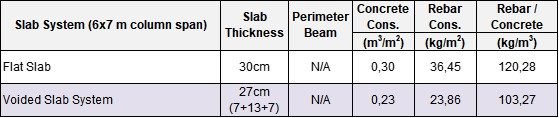 Consumption of concrete and steel reinforcement varies depending on the project. The slab thickness and Volimax disposable formwork height are determined according to the column spans between columns and walls and to the design loads of the project.
If we need to give an approximate ratio, for 6-7 m column spans, the consumption of concrete in the slab decreases by 20-25% and reinforcement consumption by 15-20%. Since this reduction reduces the self-weight of the entire structure, a reduction is also provided in the earthquake loads and loads on the foundation. While the reduction of the earthquake loads provides convenience and material savings in the structural design, the reduction of the loads on the foundation both reduces the foundation thickness and provides great savings in ground improvement costs where needed. By decreasing the self-weight of the structure, additional reductions can be achieved recursively in column & shear wall dimensions. Thus, significant additional savings can be achieved in the total amount of reinforcement.
Consumption of concrete and steel reinforcement varies depending on the project. The slab thickness and Volimax disposable formwork height are determined according to the column spans between columns and walls and to the design loads of the project.
If we need to give an approximate ratio, for 6-7 m column spans, the consumption of concrete in the slab decreases by 20-25% and reinforcement consumption by 15-20%. Since this reduction reduces the self-weight of the entire structure, a reduction is also provided in the earthquake loads and loads on the foundation. While the reduction of the earthquake loads provides convenience and material savings in the structural design, the reduction of the loads on the foundation both reduces the foundation thickness and provides great savings in ground improvement costs where needed. By decreasing the self-weight of the structure, additional reductions can be achieved recursively in column & shear wall dimensions. Thus, significant additional savings can be achieved in the total amount of reinforcement.How much concrete and reinforcement can be saved compared to two way ribbed (filled/unfilled) slabs?
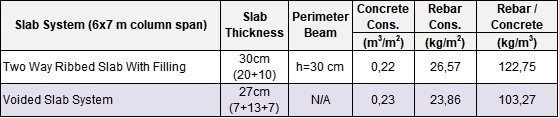 Consumption of concrete and reinforcement varies depending on the project. The slab thickness and Volimax formwork height are determined according to the column spans between columns and walls in the project and account loads.
After the thickness of the slab is determined, it will be designed as a beamless slab, as it is in two way ribbed slabs, there is no need for stirrup winding at every 70 cm. Therefore, 10-15% of reinforcement savings can be achieved. As the slab loads will decrease depending on the material used as ribbed slab filling, optimization can also be made in column/shear wall sizes.
As the column span increases, the reinforcement and concrete savings provided by the hollow flooring system will also increase.
Consumption of concrete and reinforcement varies depending on the project. The slab thickness and Volimax formwork height are determined according to the column spans between columns and walls in the project and account loads.
After the thickness of the slab is determined, it will be designed as a beamless slab, as it is in two way ribbed slabs, there is no need for stirrup winding at every 70 cm. Therefore, 10-15% of reinforcement savings can be achieved. As the slab loads will decrease depending on the material used as ribbed slab filling, optimization can also be made in column/shear wall sizes.
As the column span increases, the reinforcement and concrete savings provided by the hollow flooring system will also increase.Can a shaft opening be left in the slab?
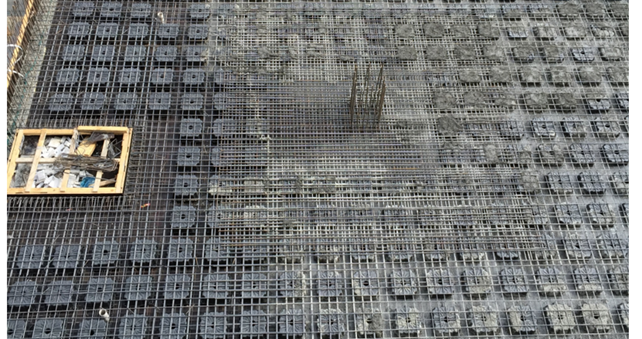 For installation passages required by the project design, an opening with a maximum diameter of 40 cm can be formed by removing a single disposable formwork where necessary and making sure that the opening is fully surrounded with concrete. For larger openings, as in any type of flooring, an open shaft can be formed in the floor by surrounding the opening with the necessary reinforcement steel according to calculations.
What type of concrete should be used?
Preferred concrete class varies depending on the project. It is recommended that the concrete consistency should be at least S4 and fine aggregate should be used to ensure that the concrete grade is at least C25 / 30 and the bottom slab is completely filled.
How is the incoming earthquake load transferred from the slab to the shear walls?
When designed as a non-beam slab, a zone of approximately "d" (punching zone) around the columns and shear walls is passed as a solid slab. Therefore, since there is a solid slab in the junction area of the shear wall and slab, the slab transfers the axial loads to the vertical elements with a filled slab, as in the standard slab without beam.
While load transfer to the beams occurs with only a thickness of 7-10 cm in one and two way ribbed (filled/unfilled) slabs, voided slab system utilizes upper and lower plates (a total of minimum 14 cm) and a full concrete area close to the shear walls realizing a more rigid slab in general.
How is its resistance to fire?
Fire resistance depends on slab thickness, bottom and top slab thickness, and concrete cover heights, as in conventional floors. It has been classified as REI 120 as a result of the fire resistance test performed in accordance with the EN 13501-2 standard in the form of 7 cm top plate + Volimax H13 cm + 7 cm bottom plate.
Does it provide sound insulation?
A voided slab constructed with Volimax disposable formworks contributes to the sound insulation between upper and lower floors thanks to the creation of air gaps in the slab.
Does it provide heat insulation?
A voided slab constructed with Volimax disposable formworks can provide a small amount of heat insulation by creating air gaps in the slab. Since there is a continuous thermal bridge between the disposable formworks, and upper and lower sectthe application of thermal insulation should be done separately.
Can it be used with post tensioning?
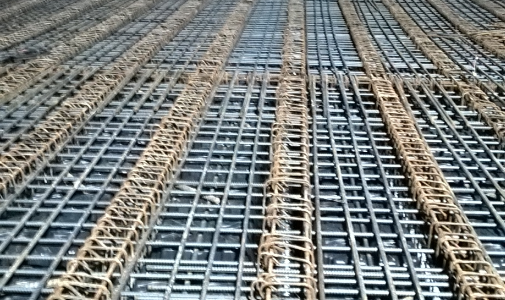 In post-tensioning systems with wide openings, when used between post-tensioning cables, the disposable formworks construct void space between the carrier cables reducing the dead weight of the slab thus also reducing the need for post tensioning cables. In turn, it can also help to reduce the slab thickness.
How is it modeled?
Generally, modeling with the Volimax voided slab system is very similar to modeling a flat slab without beams. All the information along with examples is presented in our guides on how to model the voided slab system with different building design programs on our website.
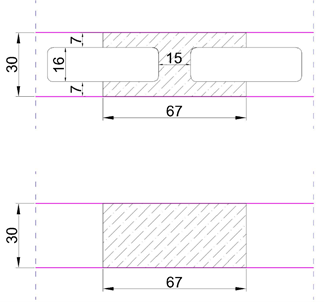
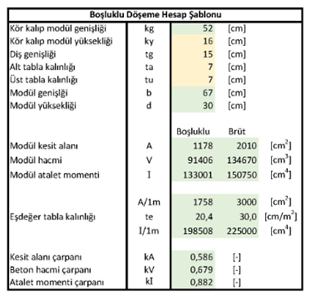
When modeling a voided slab system, first the cross-sectional value (moment of inertia, unit volume and cross-sectional area) of the 𝙸 section formed by the disposable formworks is calculated. Equivalent section coefficients are obtained by comparing voided slab cross section values with flat section values. The voided slab model is created by multiplying these coefficients with relevant parameters such as effective section stiffness, modulus of elasticity and concrete unit volume weight in the structural design software used.
Generally, the articles regulated in the new earthquake regulation TDBY 2018 for a flat slab are also valid for the voided slab system. In any case, we recommend checking the design with the finite element method.
What should be the minimum and maximum spacing of the disposable formworks?
Just like the height of the formworks, the spacing between the disposable formworks varies according to the axle distance between columns and walls and the required loads. However, it is recommended that the formwork spacing be minimum 15 cm in order to ensure a healthier in-plane load transfer in beamless slab systems.
In TS500 11.4.4.2, ``There must be at least 3 openings for beamless slabs.`` says?
These rules are valid to apply the method of moment coefficients. These rules do not apply to the finite element method.
TS500 11.4.4.2 - Moment Coefficient Method
Beamless (flat) slabs that meet all of the conditions listed below can be calculated with this approximate method. The method is only valid for vertical load analysis.
- There should be at least three openings in each direction.
- The ratio of long edge to short edge should not be more than 2.0.
- The difference between the openings of neighboring plates in any direction should not be more than 1/3 of the long span.
- The eccentricity of any column from the frame axis should not be more than 1/10 of the span in the moment calculated direction.
- The ratio of live load to permanent load should not be more than 2.0.
Does the ratio of ``ln/20`` have to be in a single span slab?
Deflection calculation may not be required if it complies with these rules. In other cases, deflection should be calculated. There is a deflection calculation requirement for non-beam (flat) slabs.
Does the core shear wall have to be at the center of the project to model the voided slab?
Voided slab modeling is not much different from a flat slab. Having the core in the middle increases the torsional rigidity of the structure. To increase the torsional stiffness that decreases in the structures where the core is not in the center, an outer frame (hanging) beam can be constructed if the architecture allows, or an outer frame beam designed with the same thickness as the slab can be connected to the columns and the shear walls. As a result of this design, the structure will still be twisted, but as the plastic deformation capability will increase, it will behave more ductile.
How much do Volimax disposable formworks weigh? How does he come to the job site?
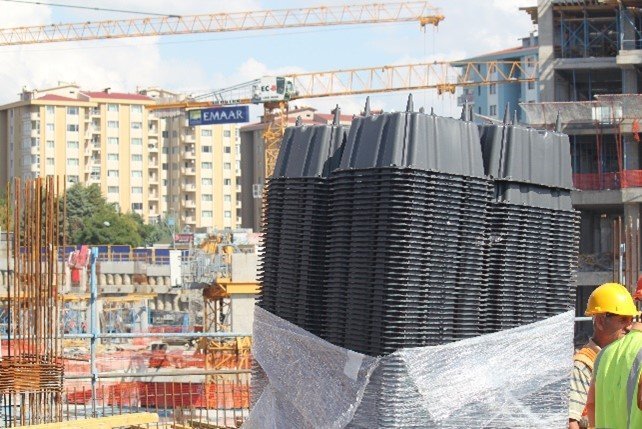
The heights of the disposable formworks are in the range of H10-H52 cm, and the weight varies between 1 and 3 kilo/piece. The disposable formworks come to the field nested with pallets and can be transported to floors with pallets. There are 400 disposable formworks in 1 pallet for H13, which covers a floor area of approximately 250 m2.
Can disposable formworks be walked on?
A single Volimax disposable formwork can carry up to 240 kg on average without the top reinforcement, according to load test results performed with a 55 mm diameter metal plate at different points of the formworks. The formwork was restored to its original state without any breaks after the load was removed.
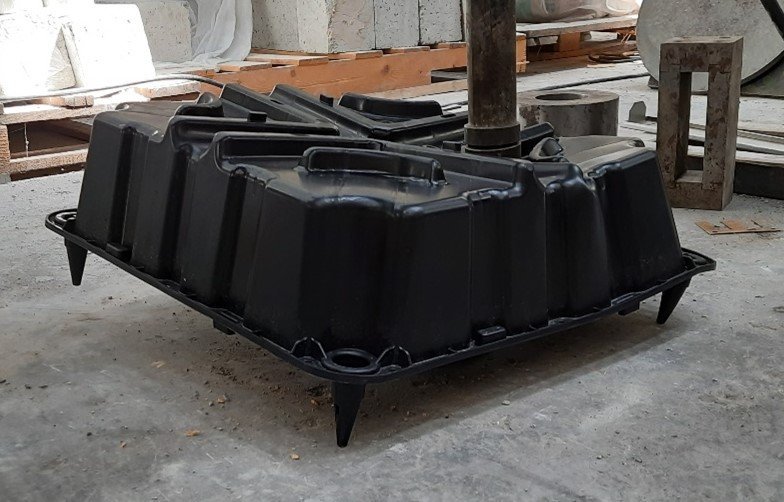 After the upper reinforcement is laid, the load on the Volimax formworks will be a distributed load, increasing its carrying capacity considerably. Under high air temperature conditions, it is recommended to water the disposable formworks before walking on them and before pouring concrete.
After the upper reinforcement is laid, the load on the Volimax formworks will be a distributed load, increasing its carrying capacity considerably. Under high air temperature conditions, it is recommended to water the disposable formworks before walking on them and before pouring concrete.How does concrete casting takes place?
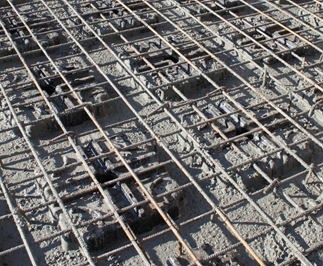
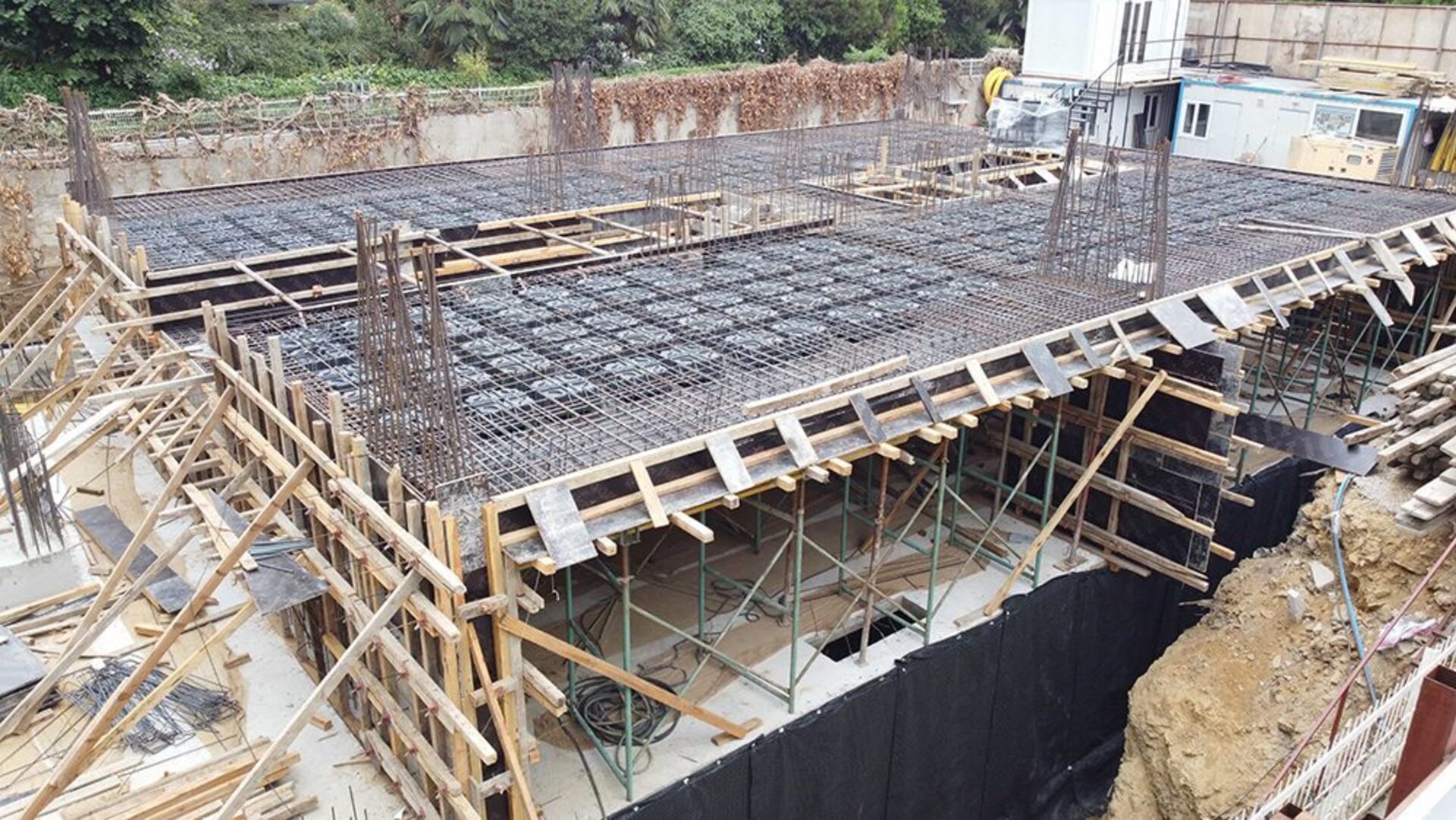
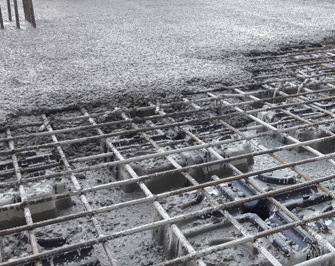 Concrete pouring takes place in two phases. In the first phase, concrete casting should be made at the ribs between the formworks until the feet of the disposable formworks are completely covered. Following the initial pouring of concrete, vibration is applied. During vibration, it must be checked that the concrete flows under the disposable formwork by observing the concrete flow through the conical opening at the center of every disposable formwork. The second phase of concrete casting should be performed on time in order not to form any cold joints. Between the two phases of concrete casting there should be a time interval of at least 1 hour or more, depending on weather conditions. In the second phase, the disposable formworks get completely covered with concrete up to the required floor level and casting of the slab gets completed after surface leveling.
Why ABS Yapı?
We are at your service with our civil engineers who have been working with us since our establishment in 2011, the most knowledgeable about voided slab design and the most experienced in field supervision.
- Different voided slab project design experience
- Field experience in dozens of construction sites next to the pump operators
- Collaboration with different designers
- A wide portfolio of experts that we can consult on every subject
Why “disposable formwork”?
When we first named the group to which these new products belong, in addition to the "disposable formwork" we also considered alternative names; crate formwork, single-use formwork, disposable mold, dead formwork… After extensive evaluations, we decided on the “disposable formwork”. In doing so, we based ourselves on the term "disposable frame", which is known and frequently used in all construction sites. Likewise, " disposable frame" describes the consumable material that determines the boundaries and size within the wall so that a door or a window can be installed.
Where is it produced?
All the products are produced in Turkey. Similarly, we have different suppliers from within Turkey for injection ready polypropylene raw materials.
How long do disposable formworks remain intact in concrete?
The main purpose of the elements used as disposable formwork is to shape the concrete. The main load bearing structure is the reinforced concrete structure formed after casting. After casting, the Volimax disposable formwork will not function, but will remain there for the entire life of the structure.
What is the decay condition of the disposable formworks under concrete?
Since the disposable formworks are not exposed to sun and weather conditions, there is no rotting. The disposable formworks will remain intact throughout the life of the building.
What is the shelf life of the products? So, can't I buy it and stock it?
Of course, it can be stocked, but should not be left in sunlight for a long time.
What is the lead time?
We keep the most frequently used types of Volimax in stock in our warehouse. Our normal production capacity for large projects is 800 pieces per day.
Do your products earn LEED certification points?
Yes, our products meet Leed score criteria in many areas such as logistical advantage and recycling of plastic. For detailed information, request the "LEED Score Chart" of the relevant product.
Why is the color black?
Recycled polypropylene plastic raw material can be in a wide variety of mixed colors, so "carbon black" is mixed into the melt to ensure integrity and avoid confusion and a black color is obtained.
What is the raw material of the products?
All our products are made of recycled polypropylene.
Does it melt from the heat of the concrete?
Polypropylene softening temperature is over 80 degrees. To create such a temperature in wet concrete after casting, very serious thicknesses are required. Such an application is also beyond the scope of disposable formworks.
What are the prices of Volimax disposable formworks?
The slab thickness and Volimax formwork height are determined according to the column spans between columns and walls in the project and the required loads on the slab. Prices vary depending on the determined Volimax height. Disposable formworks can be used in two different ways, single and double. Disposable formworks are priced based on pieces, they are generally designed as 1.6-2 pieces/m2. Please contact us for more detailed information.
How much is the application labor cost?
In terms of labor cost, placing the disposable formworks on the slab formwork is easier than clay hollow blocks and at worst it is same as EPS blocks. Since the disposable formworks are nested in each other, they can be easily transported to the application area with the help of a crane or manually. Since there is no need for reinforcement between the disposable formworks in many designs, they can be placed on the lower reinforcement easily and very quickly. The only labor-related work may occur when attaching the disposable formwork to the bottom reinforcement, but this must be evaluated together with other savings.